Blog | Lease Consultancy | Valuation | Auction | Development
Radical Reshape of Planning Use Class System
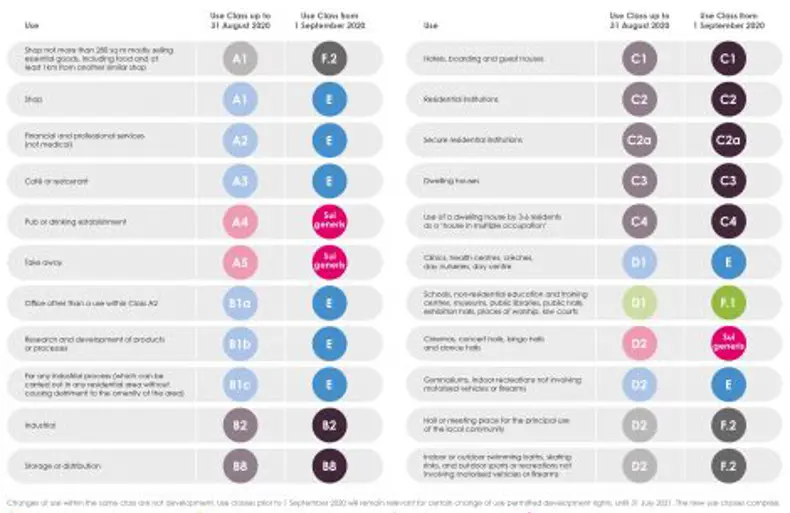
This week the Government has announced radical changes to our planning system, overhauling our current long standing Use Classes Order in favour of increased flexibility in the hope of supporting the recovery of our high streets and towns.
The new provisions will come into force on 1 September 2020 and will allow significantly greater flexibility to change uses within towns across England without the need to obtain planning permission. The changes will see us wave goodbye to Classes A1, A2, A3, B1, D1 and D2 all of which will be revoked in favour of a new Class E ‘Commercial Business and Service’. This new class will cover a wide range of uses including: retail, financial and professional services, cafés and restaurants (currently A1-A3); offices, research and development and light industrial (currently B1); clinics, health centres and nurseries (currently D1) and indoor sport and recreation (currently D2).
Two other new use classes will be introduced: Class F.1 (Learning and non-residential institutions) which currently sit within use class D1, and F.2 (Local community) which currently sit within use class D2.
As we would expect there have been some exclusions from Class E to protect uses with community value for example ‘cinemas and bingo halls’ (currently D2) and also to prevent unrestricted conversion to those uses with potential negative externalities, for example drinking establishments (currently A4) and ‘hot food takeaways’ (currently A5). These now fall within Sui Generis use and will need planning permission for change of use to or from.
 Click to view updated table
This new system will allow landlords, and tenants to a degree, to keep pace with our changing retail and leisure market; enabling redundant retail accommodation to be repurposed into a viable alternative use. Landlords are likely to benefit, being able to pick and choose the most valuable use for their property. However, whilst many positive changes are likely to occur, will such an open policy reduce the range of services our high streets have to offer?
Local authorities have always previously retained an element of power to influence the use class of a building. When the government announced, in 2015, that office buildings could automatically be converted into residential accommodation through Permitted Development Rights we saw the subsequent introduction of Article 4 Directions which provided localised powers to prevent such conversion and protect employment areas. Only time will tell if such an opportunity will arise for local authorities to soften the impact of this new legislation, however we have no doubt that many councils will want some input in shaping their built environment.
We live in a dynamic country with changing consumer and occupier habits. Our built environment needs to keep pace with these changes and this new use class system is providing us with a suitable framework. It will remove red tape, increase flexibility of land use and will allow the repurposing of redundant buildings. This can only be a good thing for our economy. We anticipate, however, that some local authorities may seek to impose restrictions to protect amongst others, core employment areas and prime retail pitches.
Related Insights

Allsop releases September residential auction catalogue with 275 lots on offer
The auction will be held over two days, with 18 lots guided at £1 million or more

Seven-Year Property Cycle? Not Any More
For decades, the UK commercial property market operated on a seven-year rhythm of boom, correction and recovery. That model i...

Why Work with a Broker When Financing Auction Property?
The speed that makes auction so attractive is also what makes finance preparation non-negotiable. Once the hammer falls, a bu...

From Graduate to £1.5bn: Alex Neil on 25 Years in the property industry
In this instalment of BE News “My BE Career” series, Alex reflects on the winding road that brought him to Allsop, and the va...